
The Possibility of Eternal Relationship
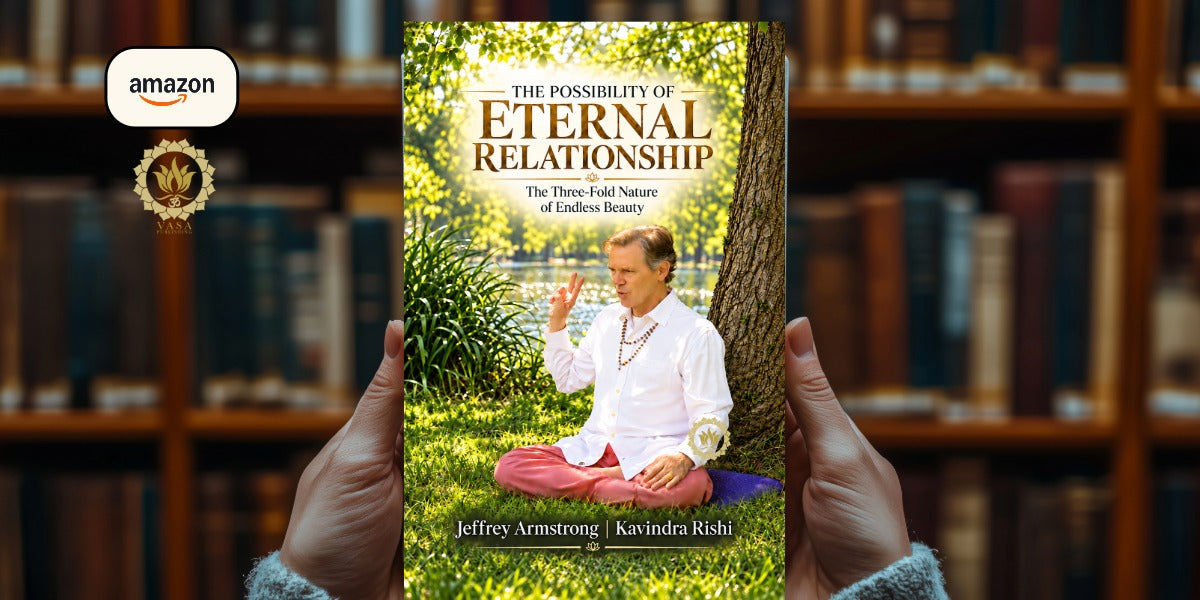
The Possibility of Eternal Relationship — A New Book by Jeffrey Armstrong | Kavindra Rishi
What if liberation does not mean the end of individuality?
What if our deepest longing for love, beauty, relationship, and belonging points toward something eternal rather than temporary?
In his new book, The Possibility of Eternal Relationship: The Three-Fold Nature of Endless Beauty, Jeffrey Armstrong | Kavindra Rishi explores one of the most profound questions in Vedic philosophy: Who are we eternally, and what becomes possible beyond karma and beyond the realization of Brahman?
Written in 108 concise verses, this small but deeply concentrated book presents the Gaudiya Vedanta understanding of eternal individuality and Divine relationship through the teachings of Sambandha, Abhidheya, and Prayojana.
Beyond Oneness
One of the great contributions of Vedic thought is the realization of Brahman—the understanding that all existence rests within one vast Divine reality.
But is Oneness the final teaching?
The Possibility of Eternal Relationship explores the view that realization does not end with the dissolution of individuality. Rather, the eternal individual remains distinct while simultaneously inseparable from the Divine.
This is expressed in the teaching of achintya-bhedābheda-tattva: the inconceivable truth that reality is simultaneously one and distinct.
From this perspective, individuality is not a temporary mistake to be erased.
It is the basis for relationship.
The Three-Fold Nature of Endless Beauty
The book is structured around three foundational teachings of Gaudiya Vedanta:
Sambandha — understanding our eternal relationship with the Divine.
Abhidheya — the process by which that relationship is cultivated and lived.
Prayojana — the ultimate fulfillment of that relationship in Divine love.
Together, these teachings offer a vision of existence in which love, beauty, individuality, and relationship are not merely temporary features of material life, but may have an eternal dimension.
A Concise Book with a Vast Question
This book was written with unusual directness and simplicity.
Rather than presenting a lengthy academic treatment, Jeffrey distills the subject into 108 succinct verses, inviting readers to contemplate each idea slowly and deeply.
At its heart is a question that has concerned seekers for centuries:
If individuality disappears at liberation, what becomes of love?
And if love is eternal, then relationship must also have an eternal foundation.
The Possibility of Eternal Relationship offers a clear and compelling exploration of that possibility.
A Lifetime of Bhakti in 108 Verses
Jeffrey Armstrong has spent more than five decades studying, practicing, and teaching Vedic philosophy and Bhakti Yoga.
This book draws from the Gaudiya Vaishnava Vedanta tradition of Shri Chaitanya Mahaprabhu, including the philosophical understanding articulated through the Govinda Bhashya of Baladeva Vidyabhushana.
Though concise, the book reflects a lifetime of contemplation on some of the deepest questions of identity, consciousness, Divine relationship, and eternal existence.
For readers familiar with Advaita, Yoga, Vedanta, the Bhagavad Gita, or Bhakti traditions, this book offers an opportunity to explore what may lie beyond the realization of Oneness.
For newcomers, it offers a remarkably accessible doorway into one of the most beautiful possibilities within Vedic thought:
that the individual remains eternally meaningful, eternally lovable, and eternally capable of relationship with the Divine.
The Possibility of Eternal Relationship: The Three-Fold Nature of Endless Beauty by Jeffrey Armstrong | Kavindra Rishi is now available.


Please upload banner from store admin blog pages
![The Bhagavad Gita Comes Alive: A Radical Translation [PB]](http://gitacomesalive.com/cdn/shop/files/GopsonsIndia_5_70x70_crop_center.jpg?v=1707827234)


